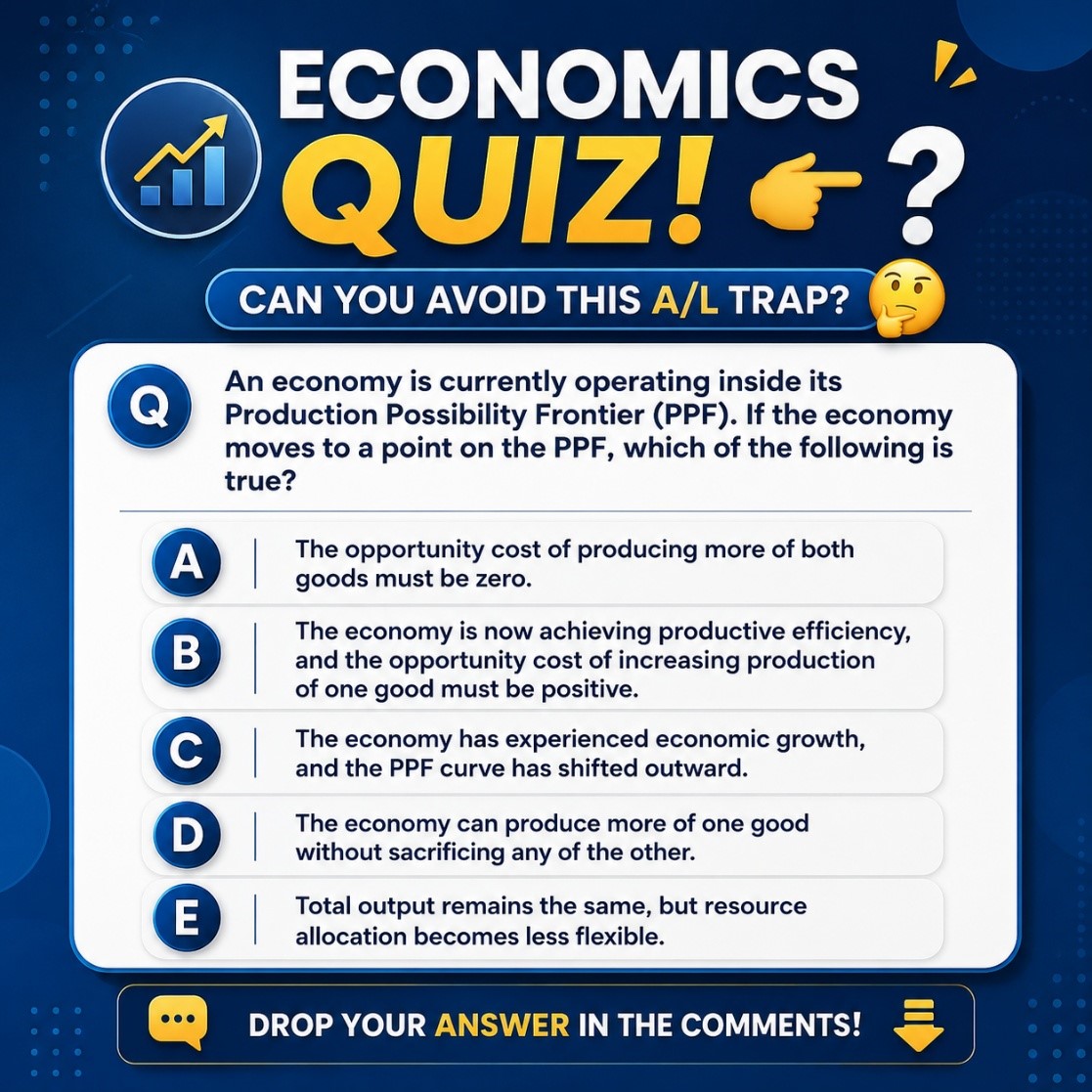
Explanation MCQ Point: The PPF Trap
Introduction
Many students struggle with the concept of the Production Possibility Frontier (PPF). Often, the confusion lies not in the definition, but in interpreting the movement along or within the curve. Today, we’re breaking down a tricky exam-style question that frequently catches students off guard. Mastering this will help you differentiate between "achieving efficiency" and "achieving economic growth."
📝 The Question
An economy is currently operating at a point inside its Production Possibility Frontier (PPF). If the economy moves to a point on the PPF, which of the following is true?
💡 Why is this the correct answer? (Step-by-Step Breakdown)
1️⃣ Understanding the Starting Point
When an economy is operating inside the PPF, it implies that resources are underutilized or unemployed. Simply put, the economy is not reaching its full potential.
2️⃣ The Shift to Efficiency (Why B is correct)
Moving to a point on the curve means the economy is now utilizing its resources fully and efficiently. This state is defined as productive efficiency. Once on the curve, the only way to increase the production of one good is to reallocate resources away from another good. This trade-off is the definition of positive opportunity cost.
🚨 Avoiding the Traps (Why the other options fail)
- ❌ A (Incorrect): Opportunity cost is never zero in a world of limited resources; there is always a trade-off.
- ❌ C (Incorrect): This is the most common exam trap! Moving from the inside to the curve is an improvement in efficiency, not economic growth. Economic growth happens only when the entire curve shifts outward.
- ❌ D (Incorrect): This is only possible if you are moving from one point inside the curve to another point still inside the curve.
- ❌ E (Incorrect): Total output actually increases when moving from the inside to the curve, as previously idle resources are now being utilized.